At a glance
- Launched today, NVIDIA Minerva is an AIOps platform built to help teams find problems earlier and keep AI factories productive
- It brings together telemetry from infrastructure and AI workloads, then applies purpose-built AI models to turn that data into timely, actionable insight
- AI factories are among the most complex operations in the world, with vast…
# NVIDIA Launches Minerva AIOps Platform for AI Factory Observability
NVIDIA has introduced Minerva, an artificial intelligence for IT operations platform designed to give operators a unified view of AI factory infrastructure. The launch targets the growing complexity of large-scale AI compute environments, where thousands of GPUs operate across high-speed networks to train models and serve applications.
The Scale Problem in AI Factories
AI factories represent some of the most complex operational environments in computing. At scale, a single degraded component can slow an entire training job or inference workload. Warning signs are often subtle—a GPU running hotter than its peers, or an NVMe drive losing performance under load—making them easy to miss with conventional monitoring.
NVIDIA frames the challenge around AI factory yield, defined as the useful work infrastructure produces. The metric encompasses GPU hours, goodput, cluster uptime, and token production. When infrastructure health declines, yield suffers, directly affecting the economics of AI compute operations.
A Dynamic Knowledge Graph for Infrastructure
Traditional data center monitoring typically splits telemetry into separate views. Networking, compute, site reliability, and machine learning teams each observe different slices of the operation. Minerva connects those signals across NVIDIA GPUs, networking, storage, schedulers, and workloads.
The platform builds a dynamic knowledge graph that logically maps infrastructure components—GPUs, SuperNICs, switches, and cables—alongside the jobs running on them. This topology-aware context allows operators to trace a slow training job to the specific component affecting it, even across factories with hundreds of thousands of GPUs.
Minerva analyzes billions of data points per hour using supervised and unsupervised machine learning. The system learns normal behavior, detects previously unseen anomalies, predicts emerging failures, and correlates related events based on the factory’s physical and logical topology. Rather than flooding operators with individual symptoms, Minerva groups event storms into focused incidents with a likely root cause.
Agentic AI and Natural Language Operations
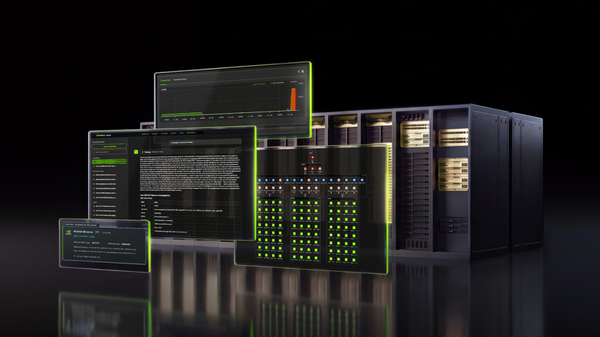
Minerva includes a native AI assistant and connects to external agentic AI tools. The combination provides a natural-language interface grounded in live telemetry. Operators can investigate cluster health and receive recommended remediation through conversation.
Teams retain the option to keep a person in the loop for manual fix implementation. Alternatively, Minerva can connect to automation through infrastructure APIs and external systems, enabling hands-off remediation where desired.
Yield Metrics and Operator Implications
NVIDIA positions Minerva as a shift from reactive to proactive maintenance for AIOps teams. The platform aggregates related problems into single actionable items, replacing alert storms with focused incidents.
The vendor cites three primary operational benefits:
- Longer time between interruptions, as Minerva spots trouble before incidents occur
- Faster time to repair, by pinpointing problems when they do happen
- Greater insight, filtering infrastructure data floods down to the alerts that matter
For data center operators, these capabilities translate directly to GPU uptime and workload continuity. In AI factories where idle GPU hours represent lost revenue, early detection of thermal anomalies, storage degradation, or network issues can protect significant capital investments.
Ecosystem Adoption and Partnerships
IREN is among the NVIDIA partners using Minerva to optimize its AI factories. Denis Skrinnikoff, chief technology officer of IREN, stated that the platform gives his operations team one view across the network, GPUs, and running jobs, enabling a focus on proactive maintenance rather than troubleshooting. He added that this visibility strengthens IREN’s operating model for the infrastructure it is building next.
Additional organizations planning to deploy Minerva include Aolani, Bitdeer AI, IBM, Jio, Lambda, Quake AI, and Tesla. On the hardware side, Dell Technologies, Lenovo, and Supermicro will offer Minerva as part of their AI factory operations portfolios.
Market Context
The launch arrives as AI infrastructure deployments grow in size and complexity. Operators managing hundred-thousand-GPU clusters face mounting pressure to maximize utilization and minimize downtime. Observability platforms that unify telemetry across compute, network, and storage layers address a gap left by traditional domain-specific monitoring tools.
By integrating supervised and unsupervised learning with agentic AI interfaces, NVIDIA is positioning Minerva as both an analytics layer and an operational interface for the next generation of AI infrastructure. Whether the platform delivers on its yield promises will depend on real-world deployment across the partner ecosystem now beginning to adopt it.

MegaWatt Intelligence Desk
Hyperscale & Grid Analyst. `More stories by $MegaWatt Intelligence Desk →`