At a glance
- We checked out the ASRock Rack booth at OCP 2026 and saw servers ranging from fully integrated NVIDIA NVL72 racks to liquid-cooled switches
# ASRock Rack Showcases Liquid-Cooled NVIDIA Vera Rubin Systems at OCP 2026
At OCP Global Summit 2026 in San Jose, ASRock Rack presented a broad portfolio of NVIDIA-powered infrastructure, with liquid cooling serving as the central design theme across rack-scale and standalone server systems.
Rack-Scale Vera Rubin Deployment
The centerpiece of the booth was the XGMRACK-VR/NVL72, ASRock Rack’s implementation of the NVIDIA Vera Rubin NVL72 architecture. The system is a 48RU NVIDIA MGX rack featuring a 5000A busbar and a liquid manifold. It houses 18 Vera Rubin compute trays and nine NVLink 6 switch trays, delivering a total of 36 NVIDIA Vera CPUs and 72 NVIDIA Rubin GPUs.
NVIDIA lists the full rack at 3,600 PFLOPS of NVFP4 inference (sparse) and 2,520 PFLOPS of NVFP4 training (dense). The system includes 20.7TB of HBM4 memory, with each Rubin GPU allocated 288GB.
Power is supplied by four 3RU 19-inch power shelves, each rated at 110kW and utilizing six 18.3kW PSUs alongside bulk capacitors. ASRock Rack offers multiple cooling distribution unit (CDU) configurations, including in-rack, in-row, RDHx, or liquid-to-air sidecar options.
Each compute tray follows a 1U NVIDIA MGX design containing two Vera Rubin Superchips. In this configuration, each Superchip connects two Rubin GPUs to one Vera CPU via NVLink-C2C. Networking is provided by eight 800Gbps OSFP ports from NVIDIA ConnectX-9 SuperNICs, supplemented by two 400Gbps QSFP112 ports from an NVIDIA BlueField-4 DPU. Management switches at the top of the rack handle lower-speed networking. The trays are fully liquid-cooled, an approach NVIDIA and its partners have advanced across several generations to reduce total rack power consumption.
2U HGX Rubin NVL8 Server
Alongside the rack-scale system, ASRock Rack displayed the 2U16X-GNR2/DLC RUBIN, which places an NVIDIA HGX Rubin NVL8 board with eight Rubin GPUs into a 2U chassis. The system is fully liquid-cooled, covering E1.S drives, CPUs, and GPUs, and operates without fans. Power is delivered via a 54V DC busbar.
The host platform is a dual-socket Intel Xeon 6 design supporting Xeon 6700P, 6500P, and 6700E series processors in LGA 4710 sockets. The platform provides 16+16 DIMM slots at 2DPC. Networking includes NVIDIA ConnectX-9 SuperNICs and BlueField-4 DPUs, with eight 800Gbps OSFP ports. The server also features eight hot-swap E1.S NVMe bays. NVIDIA quotes 400 PFLOPS of NVFP4 compute (sparse) for the HGX Rubin NVL8 platform.
ASRock Rack noted that the HGX 8-GPU platform underwent major changes in this generation, including a change in GPU orientation within the tray to enable operation in high-density, liquid-cooled racks.
Additional Cooling and Networking Technologies
Beyond the primary server systems, the booth featured two NVIDIA MGX RTX PRO servers and a dual NVIDIA Vera CPU server. ASRock Rack also displayed a liquid-cooled NVIDIA Spectrum-X SN6600-LD switch and a passively cooled NVIDia RTX PRO 4500 Blackwell Server Edition GPU.
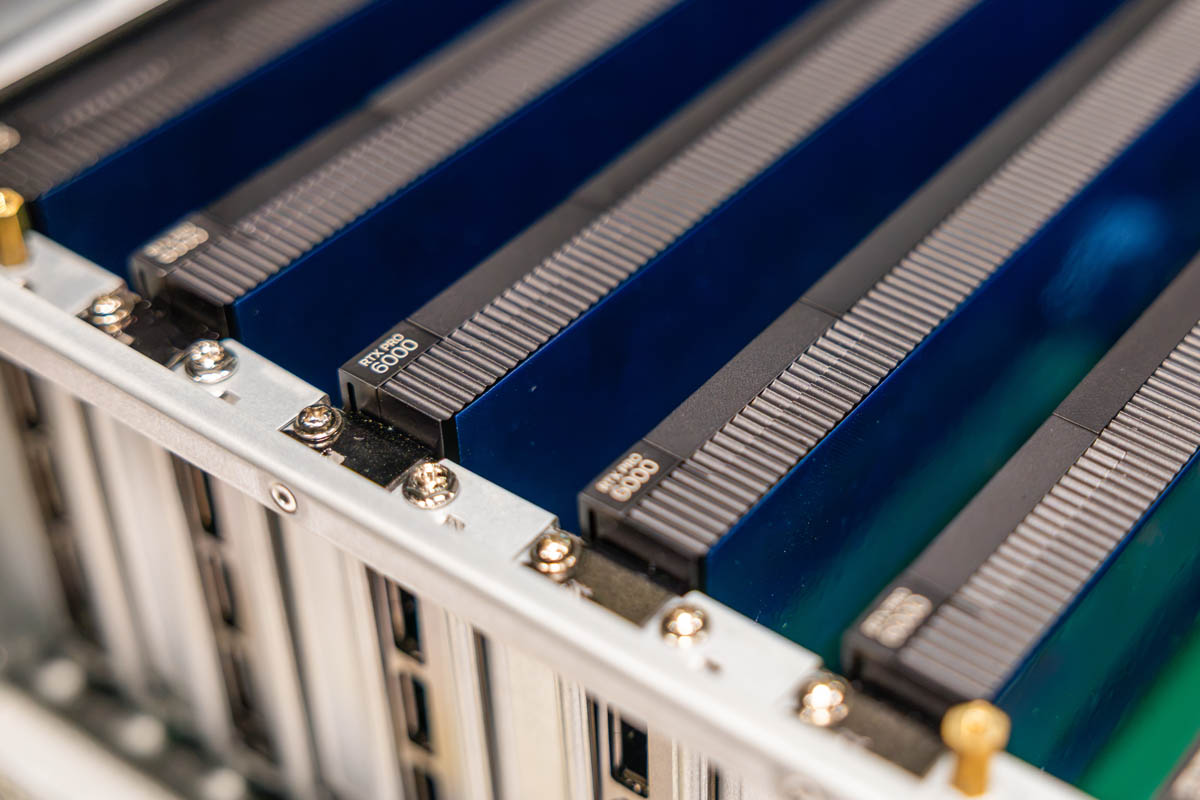
Direct-to-chip liquid cooling was applied to the rack-scale system, HGX servers, and an 8x RTX PRO 6000 PCIe server. The company also exhibited hybrid-cooled servers, reflecting a range of thermal management strategies for AI infrastructure deployments.
Operator Implications
The concentration of 110kW power shelves and direct-to-chip cooling in a single 48RU rack underscores the escalating power density requirements for next-generation AI clusters. Data center operators evaluating these systems must account for CDU integration, busbar power delivery, and facility-level liquid cooling infrastructure. The availability of multiple CDU options—from in-rack to sidecar configurations—provides flexibility for facilities at different stages of liquid cooling adoption.
The shift toward fanless 2U HGX systems and reoriented GPU trays signals that rack design and airflow management are being fundamentally rethought around liquid cooling rather than retrofitted onto air-cooled architectures. For operators, this implies that future procurement decisions will increasingly hinge on CDU compatibility, manifold design, and power shelf density as much as on GPU count or interconnect bandwidth.

MegaWatt Intelligence Desk
Hyperscale & Grid Analyst. `More stories by $MegaWatt Intelligence Desk →`