At a glance
- Will include a field demonstration at the Sky Data Centers site in Santa Rosa, California
# Renewable Innovations Joins DOE Fuel Cell Project for AI Data Centers
A U.S. Department of Energy-backed research initiative is moving forward to test fuel cell systems designed specifically for AI-driven data center workloads. Renewable Innovations has joined the project, which will include a field demonstration at the Sky Data Centers site in Santa Rosa, California.
Project Scope and Leadership
The initiative, titled “FC-DC: Fuel Cell Solutions for Brownfield and Greenfield Data Centers,” is led by the DOE’s National Laboratory of the Rockies (NLR). The project is slated to run for three years and was selected through the DOE’s Alternative Fuels and Feedstocks Office.
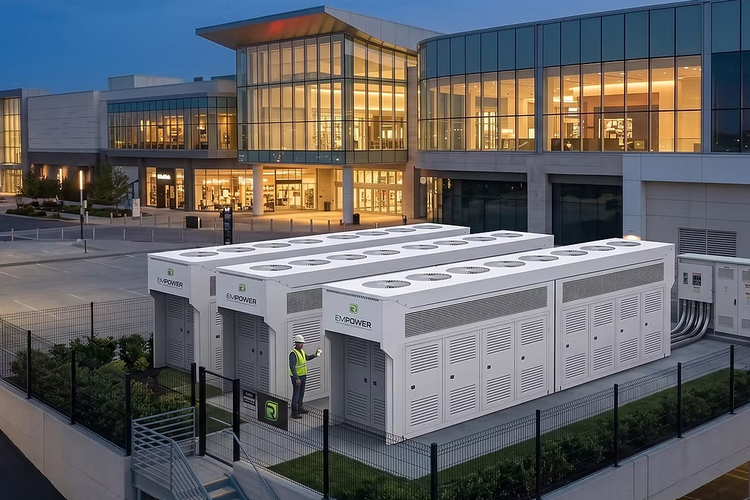
Renewable Innovations will design, build, and validate a fuel cell rack system intended to power and cool a high-power compute rack directly on the data center floor. The research will test how tightly coupled fuel cell and compute-rack architectures handle the dynamic power profiles associated with AI workloads.
NLR will develop reference designs for both brownfield retrofits and greenfield facilities. These designs will incorporate 800VDC power distribution and fuel cell integration. The laboratory will also conduct digital real-time simulation, hardware-in-the-loop testing, and transient testing to validate system performance.
Field Demonstration
The project includes a field demonstration at the Sky Data Centers site in Santa Rosa, California. This demonstration will evaluate fuel cell integration with 800VDC data center power architectures.
The announcement does not include a date for the Santa Rosa deployment. It also does not specify the rack system’s power rating or the fuel supply to be used for the demonstration.
Technical Objectives
According to Steve Hammond, senior research advisor at NLR, moving power generation directly to the compute load eliminates complex distribution paths and energy loss typical of traditional power systems. The release states this approach makes the power process more efficient and responsive.
The project will explore architectures intended to reduce conversion losses and water consumption. Efficiency, noise, and water benefits are listed as stated goals of the initiative.
Renewable Innovations CEO Bob Mount noted that the company demonstrated more than seven years ago that hydrogen fuel cells could provide reliable power for data centers. Mount said fuel cells offer an opportunity to rethink how power is generated, distributed, and managed inside the data center.
Prior Work and Partners
The project builds on earlier collaboration between Renewable Innovations, NLR, and Hewlett Packard Enterprise. In that prior work, the three organizations demonstrated a 70kW fuel cell integrated with cloud computing racks at NLR’s Energy Systems Integration Facility.
Other project partners include Nvidia, Energy Vault, DRG Technical Solutions, HPE Labs, and Alderbuck Energy. Additional organizations are providing technical support.
The primary aim of the initiative is to produce a commercialization-ready blueprint for fuel cell-powered data centers. The announcement does not disclose the project’s funding level.
Company Background
Renewable Innovations was founded in 2019 and is headquartered in Lindon, Utah. The company develops modular, scalable hydrogen fuel cell and energy storage systems. Its primary focus is on Proton Exchange Membrane hydrogen fuel cells, though it has also begun exploring Solid Oxide Fuel Cells to power baseload offtakers such as data centers.
Market Context
Fuel cells are growing in popularity across the data center sector. Bloom Energy is described as the biggest player in this space, having signed deals with several major operators and cloud firms, including Nebuis, Equinix, and Oracle.
The broader trend reflects increasing pressure on data center power infrastructure as AI compute demand rises. Operators are evaluating alternative generation and distribution architectures to address grid constraints and sustainability targets.

MegaWatt Intelligence Desk
Hyperscale & Grid Analyst. `More stories by $MegaWatt Intelligence Desk →`