At a glance
- In the not-too-distant past, data center infrastructure decisions largely centered on individual components such as racks, servers, power management, and cooling
- But AI and high-performance compute (HPC) have changed that model
- As compute becomes more powerful and infrastructure more complex, it takes an ecosystem of..
The AI Ecosystem: How Partnerships Power AI Infrastructure
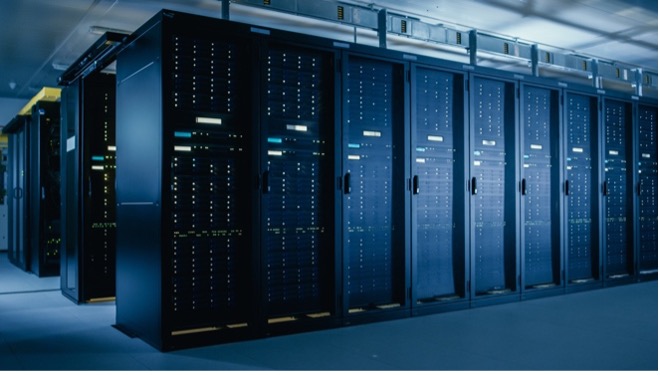
Data center infrastructure planning once centered on discrete components—racks, servers, power management, and cooling. The rise of artificial intelligence and high-performance compute has dismantled that model. Deploying modern AI workloads now requires an ecosystem spanning advanced compute vendors, hardware manufacturers, systems integrators, software providers, and service organizations. No single company can address the complexity alone.
Power Density Rewrites the Design Brief
The scale of the shift is evident in rack-level power consumption. Five years ago, a typical data center rack drew between 5 and 10 kilowatts. Today, racks used for advanced computing have exceeded 100 kilowatts. Uptime Institute notes that NVIDIA’s Blackwell NVL72 platform is rated at 132 kilowatts per rack.
That power density creates an immediate thermal consequence: for every watt consumed, one watt of heat must be removed. Cooling, historically treated as an afterthought, has become intrinsic to building design. High-density systems now require liquid cooling architectures involving pipes, manifolds, and cooling distribution units (CDUs), fundamentally changing how data centers are engineered.
Connecting the Infrastructure Behind AI
Schneider Electric positions itself as an infrastructure provider that connects mechanical, electrical, software, management, and sustainability capabilities across the AI infrastructure lifecycle. The company helps customers and partners design, simulate, build, operate, maintain, and optimize AI environments using reference designs, modeling, digital twins, management software, and sustainability expertise.
Coordination across the ecosystem must happen early. By collaborating during the design and validation phase, partners can identify integration challenges before deployment, reduce implementation risks, and improve deployment readiness. Schneider works with ecosystem partners to develop validated reference architectures, power and cooling designs, and ecosystem testing intended to reduce planning risk and accelerate deployment.
The company currently provides digital twins, simulation initiatives, and reference designs for NVIDIA’s GB200 and GB300 NVL72 chips and AMD Helios chips, supported by pre-engineered power and liquid-cooling frameworks. Schneider also draws on a long heritage of working with system integrators entering the AI and HPC space, as well as hyperscalers, colocation operators, and enterprise-class data centers.
Turning AI Infrastructure Into Business Value
Schneider’s role is to connect compute roadmaps with deployable power, cooling, physical infrastructure, software, and lifecycle expertise. Working with manufacturers, data center operators, and integrators, the company aims to make it easier for customers to leverage technology innovations and accelerate time to first token (TTFT), allowing participants across the value chain to derive financial benefit from AI implementations.
As AI infrastructure scales, Schneider helps customers optimize power, cooling, energy management, resilience, and carbon performance throughout the infrastructure lifecycle. The company’s Advisory Services team, comprising more than 4,000 consultants worldwide, assists organizations in developing renewable energy, decarbonization, and resource-efficiency strategies intended to support long-term business growth and sustainability objectives.
Trusted Collaboration Across the AI Ecosystem
Bringing increasingly powerful compute online requires coordination across compute platforms, servers, racks, power, cooling, software, and the data center itself. Schneider Electric works across these layers, collaborating with advanced compute vendors, systems integrators, hyperscalers, colocation providers, and enterprise data centers to turn AI technology roadmaps into deployable, reliable infrastructure.
Through reference designs, modeling, testing, and close ecosystem coordination, partners can address power, cooling, and physical infrastructure requirements earlier in the design process. The intended outcomes are reduced design rework, improved deployment readiness, and an accelerated path from planning to operational AI capacity. As AI infrastructure continues to evolve, this collaboration will become even more important.


MegaWatt Intelligence Desk
Hyperscale & Grid Analyst. `More stories by $MegaWatt Intelligence Desk →`